If your business sells to real estate professionals — whether you offer mortgage products, SaaS tools, insurance, marketing services, photography, staging, or coaching — then learning how to market to real estate agents effectively is the single most important skill you can develop in 2026.
There are over 2 million licensed real estate agents in the United States. They spend billions annually on tools, technology, marketing, and services to run their businesses. That makes them one of the most attractive B2B audiences in the country. But reaching them requires the right strategy, the right data, and the right messaging.
In this guide, we'll break down every channel, tactic, and best practice for marketing to realtors — so you can build a predictable pipeline of agent leads, close more deals, and grow your revenue.
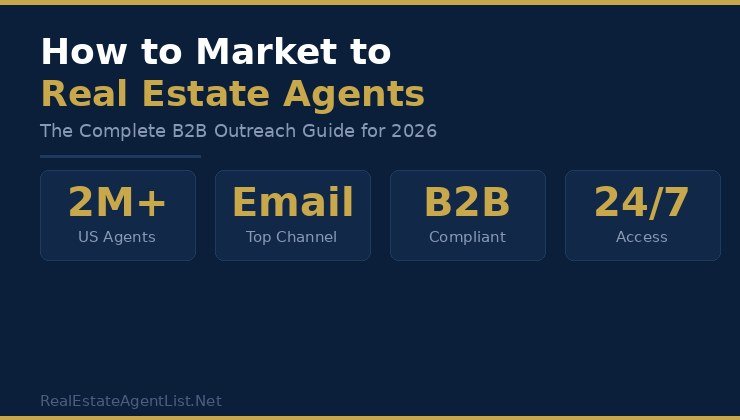
Over 2 million licensed real estate agents in the US represent a massive B2B opportunity for companies selling products and services to the industry.
Why Real Estate Agents Are a High-Value B2B Audience
Real estate agents aren't just individual consumers — they're small business owners who actively invest in their operations. A typical agent spends money on CRM software, lead generation tools, marketing platforms, professional photography, staging services, continuing education, insurance, signage, and more.
What makes them especially attractive as a B2B target is that their contact information is publicly available. Agents list their names, emails, phone numbers, and office details on platforms like Realtor.com, Homes.com, RE/MAX, and state association directories. This means you can reach them directly without relying on expensive advertising middlemen.
The key numbers you need to know: the United States has approximately 2,130,616 licensed real estate agents spread across all 50 states. The largest markets are California (441,315 agents), Florida (311,607 agents), and Texas (213,570 agents). Whether you're targeting a single state or going national, the audience is there.
Channel 1: Cold Email — The Highest-ROI Strategy
Cold email remains the single most cost-effective way to market to real estate agents at scale. It costs pennies per contact, delivers directly to their inbox, and can be personalized, automated, and tracked with precision.
Here's why it works so well for this audience: real estate agents check their email constantly. Their business depends on fast communication with clients, lenders, and other agents. Unlike consumers who might ignore promotional emails, agents treat their inbox as a primary business tool.
To run an effective cold email campaign, you need three things:
- A quality real estate agent email list — with verified email addresses, segmented by state and enriched with data like office name, phone number, and experience level
- An email sending platform — tools like Instantly.ai, Lemlist, or Mailshake are built for cold outreach with built-in warm-up, deliverability tracking, and sequence automation
- Personalized, value-first messaging — short emails (under 150 words) with a clear hook, a specific value proposition, and one call-to-action
For ready-to-use scripts you can adapt to your business, see our guide on 10 proven cold email templates for real estate agents.
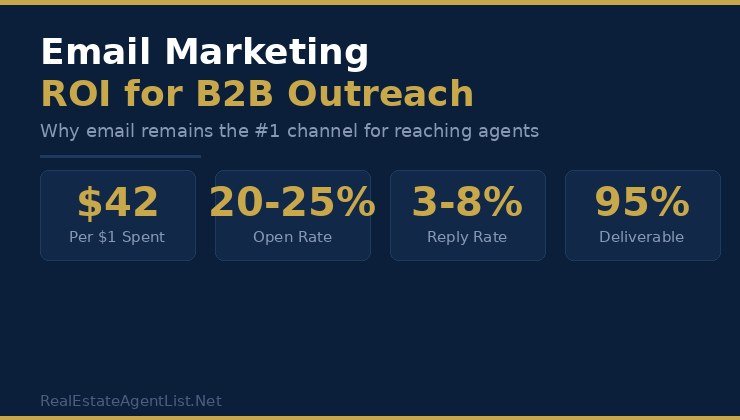
Email marketing consistently delivers the highest ROI of any B2B outreach channel — averaging $42 returned for every $1 spent.
Pro tip: Always verify your email list with NeverBounce or ZeroBounce before sending. Removing invalid addresses protects your sender reputation and keeps deliverability above 95%.
Channel 2: LinkedIn Outreach
LinkedIn is where real estate agents present their professional identity. Many agents — especially those at larger brokerages — maintain active LinkedIn profiles. For B2B companies selling SaaS, coaching, or high-ticket services, LinkedIn offers a way to build relationships before pitching.
Effective LinkedIn strategies for reaching agents include:
- Connection requests with personalized notes — mention their market or brokerage to stand out
- Content marketing — post industry insights and tips that agents find useful, positioning your brand as a trusted resource
- LinkedIn Sales Navigator — filter by job title ("Real Estate Agent"), location, and company to build targeted prospect lists
- Direct messaging sequences — follow up with 2–3 messages after connecting, offering value before asking for a meeting
LinkedIn works best as a complement to email, not a replacement. The most effective B2B campaigns combine email outreach with LinkedIn touchpoints — an agent who sees your email and your LinkedIn profile feels more familiar with your brand and is more likely to respond.
Channel 3: Direct Mail
In a world where everyone is sending emails, physical mail stands out. Real estate agents are already familiar with direct mail — many use it themselves for farming campaigns — so they're receptive to well-designed mailers that arrive at their office.
What works for direct mail to agents:
- Postcards — affordable, eye-catching, and easy to produce at scale
- Personalized letters — especially effective for high-ticket offers like coaching programs or franchise recruitment
- Sample kits — if you sell a physical product (signage, business cards, photography packages), send a sample
A comprehensive realtor contact database that includes office addresses gives you everything you need to launch a direct mail campaign alongside your digital outreach. The 24 data fields in a quality database typically include full office address, city, state, and ZIP — ready for mail merge.
Channel 4: Paid Advertising
If you have the budget, paid ads let you reach real estate agents at scale without building a contact list first. The two most effective platforms for this audience are:
Facebook and Instagram Ads: You can target users by job title ("Real Estate Agent," "Realtor," "Real Estate Broker"), location, and interests. Facebook's custom audience feature also lets you upload your realtor email list and serve ads directly to those contacts — reinforcing your email outreach with visual touchpoints.
Google Ads: Target agents searching for tools and services with keywords like "best CRM for real estate agents" or "real estate marketing tools." These are high-intent searches from agents actively looking to buy — but competition is fierce and cost-per-click is high.
Paid ads work best when combined with other channels. An agent who sees your ad, receives your email, and notices your LinkedIn connection request is far more likely to convert than one who only encounters your brand through a single touchpoint.
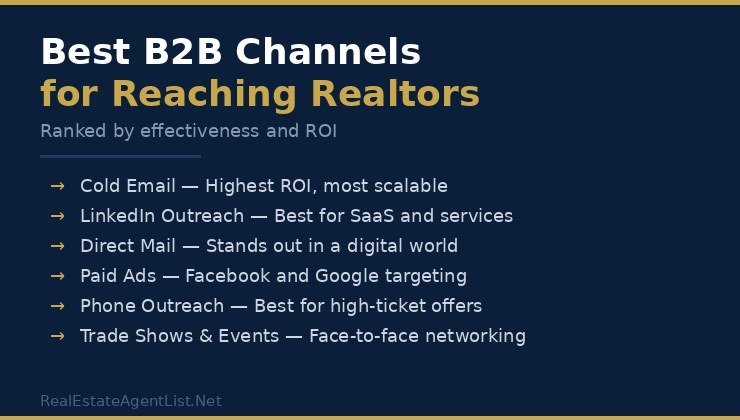
The most effective B2B marketers use multiple channels — email, LinkedIn, direct mail, and ads — to reach agents across different touchpoints.
How to Segment Your Realtor Audience
One of the biggest mistakes companies make when marketing to real estate agents is treating all 2 million agents as a single audience. They're not. A first-year agent in rural Kansas has completely different needs, budget, and pain points than a 20-year veteran running a team in Manhattan.
Segmentation is what separates campaigns that convert from campaigns that get ignored. Here are the most effective ways to segment:
- By state or metro area — target agents in the specific markets where your product is most relevant. Browse our complete state-by-state breakdown to see agent counts per state.
- By experience level — new agents need training, tools, and leads. Veterans need efficiency, automation, and premium services.
- By brokerage affiliation — agents at Keller Williams have different tech stacks than RE/MAX agents or independents. Tailor your pitch accordingly.
- By online presence — agents with personal websites and active social profiles are more tech-savvy and responsive to digital outreach.
- By transaction volume — top producers have bigger budgets but less time. Newer agents have more time but tighter budgets.
A quality real estate agent email list with 24 data fields per record gives you the information you need to segment effectively — including state, city, office name, experience level, social profiles, and website.
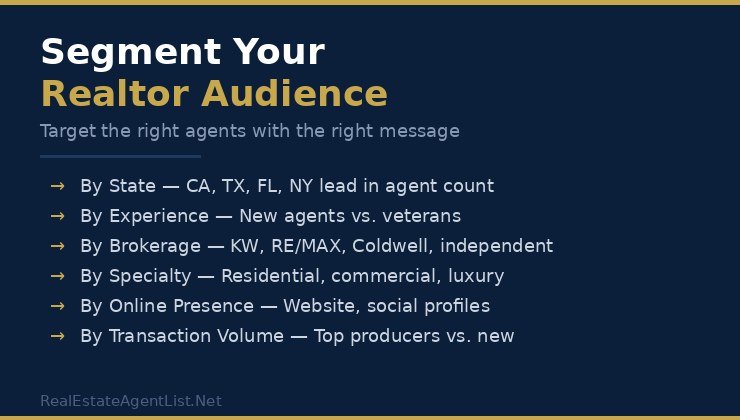
Effective segmentation means sending the right message to the right agents — dramatically improving your open rates, reply rates, and conversion.
Crafting a Message That Resonates With Agents
Real estate agents are busy, skeptical, and bombarded with marketing daily. Your message needs to earn their attention in the first sentence or it's getting deleted. Here's what works:
Lead with their pain point, not your product. Don't open with "We're a company that does X." Open with the problem they're experiencing: "Tired of spending hours on follow-ups that go nowhere?" or "Most agents in [city] leave 30% of their leads untouched."
Be specific. Generic messages get generic results. Mention their city, their brokerage, or a specific challenge in their market. The more specific you are, the more it feels like a one-to-one conversation instead of a mass blast.
Offer value before asking for anything. A free resource, a market report, a case study showing how agents like them got results — these build trust before you ask for a meeting or a sale.
Keep it short. Cold emails should be under 150 words. LinkedIn messages under 100. If your pitch requires a paragraph of explanation, it's too complicated. Simplify your value proposition until you can say it in one sentence.
For a deeper dive into exactly what to say and how to say it, read our step-by-step guide to using a real estate agent email list for B2B marketing.
CAN-SPAM Compliance: What You Must Know
Sending marketing emails to real estate agents is perfectly legal — but you must follow CAN-SPAM regulations. This isn't optional. Violations can result in fines of up to $51,744 per email.
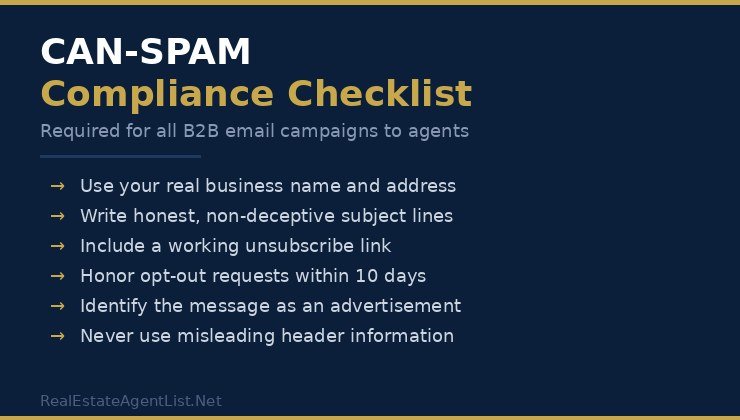
CAN-SPAM compliance is mandatory for all B2B email campaigns. Following these rules protects your business and your sender reputation.
The requirements are straightforward:
- Use your real business name and physical address in every email
- Write honest subject lines — no deceptive or misleading content
- Identify the message as an advertisement when applicable
- Include a working unsubscribe link in every message
- Honor opt-out requests within 10 business days
- Never use misleading header information (From name, Reply-To, etc.)
Every reputable email platform (Mailchimp, ActiveCampaign, Instantly, Lemlist) handles most of this automatically — including unsubscribe links and sender identification. As long as you're using a proper tool and not blasting from a personal Gmail account, compliance is manageable.
Remember: real estate agents are licensed professionals whose contact details are publicly listed for business communication. Marketing to them via email is a standard B2B practice — not spam — as long as you follow the rules.
Building Your Outreach System: A Step-by-Step Playbook
Here's how to put it all together into a repeatable system that generates agent leads consistently:
- Get your data — purchase a real estate agent email list covering your target states, or start with the full national database for maximum reach
- Verify your emails — run the list through NeverBounce or ZeroBounce to remove invalid addresses and protect deliverability
- Segment — break your list into targeted groups by state, experience level, brokerage, or market size
- Write your sequences — create a 3–4 email sequence with a personalized first touch, a value-add follow-up, a case study or social proof email, and a final check-in
- Launch and track — send your first batch, monitor open rates, reply rates, and bounces. Aim for 25%+ open rate and 3–8% reply rate
- Optimize — A/B test subject lines, adjust send times, refine your targeting. Small improvements compound into dramatically better results over time
- Layer in additional channels — add LinkedIn touchpoints, retargeting ads, or direct mail to agents who opened but didn't reply
This system scales. Whether you're targeting 500 agents in a single city or 500,000 agents nationwide, the process is the same — only the volume changes.
Ready to Start Marketing to Real Estate Agents?
Get instant access to 2.1M+ licensed US realtors with emails, phone numbers, office details, and 24 data fields per record. Browse by state or grab the full national database.
View Pricing & Download →Industries That Successfully Market to Agents
Not sure if your business fits? Here are the industries that see the strongest results from marketing to real estate agents:
- Mortgage and lending companies — build referral pipelines by connecting with agents who bring in homebuyers daily
- Real estate SaaS and PropTech — demo your CRM, transaction management, lead gen, or marketing automation tools via cold email at scale
- Marketing agencies — offer social media management, SEO, content creation, or ad management to agents who know they need marketing help but don't have time to do it themselves
- Insurance providers — reach agents who need E&O insurance, general liability, title insurance, and other professional coverage
- Real estate brokerages — recruit experienced agents from competing brokerages using targeted outreach filtered by state, experience, and transaction volume
- Service vendors — sell photography, videography, staging, signage, virtual tours, home inspection, and other services agents purchase regularly
- Training and coaching companies — market CE courses, coaching programs, and certification offerings to agents at every career stage
The common thread: all of these businesses need a direct line to agents. And the most efficient way to get it is through a comprehensive, up-to-date realtor email database.
Frequently Asked Questions
What is the best way to market to real estate agents?
Cold email is the most cost-effective and scalable channel. A quality realtor email list with verified contacts, combined with personalized messaging and proper CAN-SPAM compliance, consistently delivers the highest ROI. For best results, layer in LinkedIn touchpoints and retargeting ads to create multiple brand impressions.
How many real estate agents are there in the United States?
There are approximately 2,130,616 licensed real estate agents across all 50 states as of 2026. The largest populations are in California (441,315), Florida (311,607), and Texas (213,570). You can view the complete state-by-state count here.
Is it legal to send marketing emails to real estate agents?
Yes. Real estate agents are licensed professionals whose contact information is publicly available for business communication. Sending B2B marketing emails is legal under CAN-SPAM as long as you include proper sender identification, honest subject lines, a physical mailing address, and a working unsubscribe mechanism in every message.
Where can I get a list of real estate agents to market to?
You can compile your own list by manually searching public directories like Realtor.com, Homes.com, and state association websites. Alternatively, you can purchase a pre-compiled realtor email database that aggregates data from multiple public sources into a single, clean file — saving weeks of manual research.